
The most permanent decision you’ll make for your kitchen isn’t the paint on the walls, but the stone on your counters. It’s completely natural to feel a sense of hesitation when scrolling through endless quartz worktop colours online. You’ve likely worried that a slab will look vastly different under your own kitchen lights or that a striking vein will be interrupted by a clumsy, visible seam. We understand that you want a premium finish that feels both contemporary and timeless without the stress of maintenance or installation errors.
In this guide, you’ll discover the most sought-after quartz worktop colours for 2026 and learn how to choose the perfect palette for your London home. We’ve distilled the upcoming trends into four viable categories that balance aesthetic appeal with long-term durability. You’ll gain the confidence to predict how different stones behave under varied lighting conditions. We also explain how our master-level templating process bridges the gap between a raw slab and a precision-fitted masterpiece. By the end, you’ll have a clear roadmap to a kitchen that looks as good in reality as it does in your imagination.
Key Takeaways
- Discover why 2026 is moving away from stark whites towards warm, organic neutrals that create a more inviting kitchen atmosphere.
- Learn how to categorise the latest quartz worktop colours into distinct styles, from timeless marble-effect patterns to modern industrial finishes.
- Understand how London’s unique architecture, including basement flats and high-rise penthouses, influences how stone colours appear under different lighting.
- See why a physical sample is essential and how professional on-site measurement ensures your chosen pattern flows seamlessly around hobs and sinks.
- Gain peace of mind by working with a local London specialist who provides a complete end-to-end service, from bespoke templating to precision fitting.
The Evolution of Quartz Worktop Colours in 2026
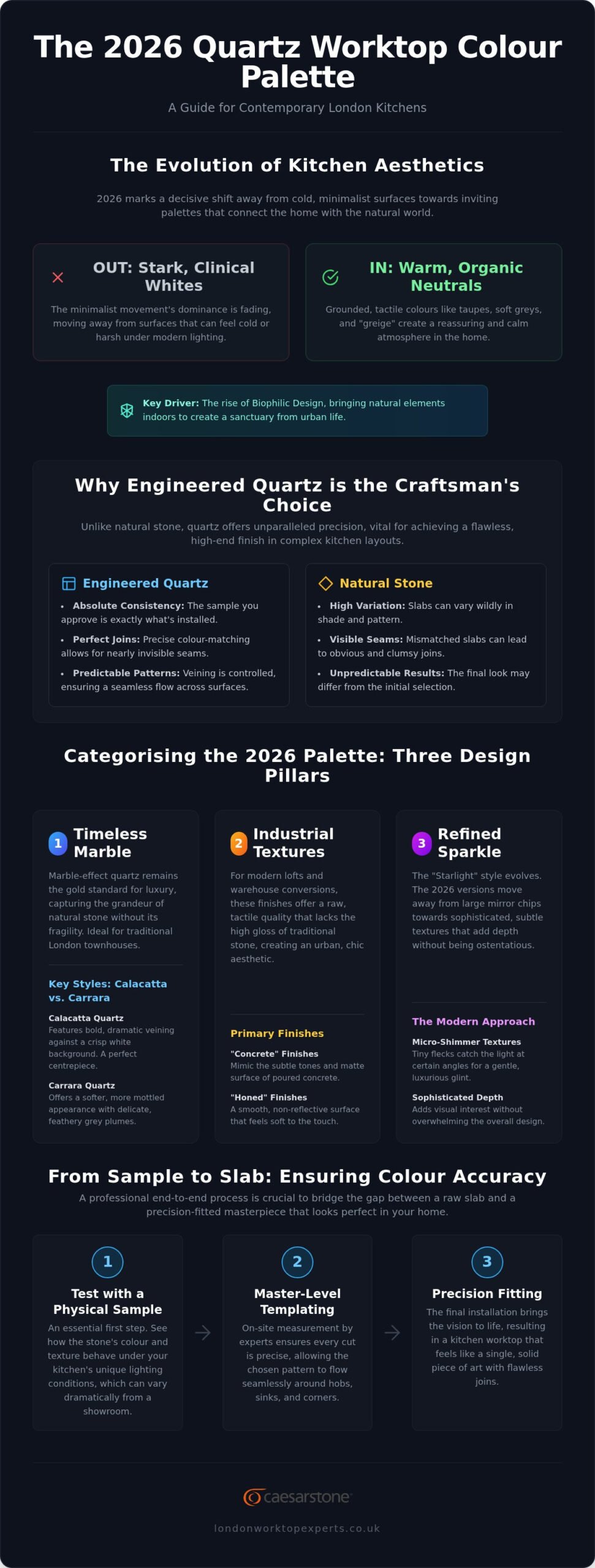
Quartz is a high-performance engineered stone, crafted by blending ground natural quartz with advanced polymer resins. This manufacturing process unlocks a limitless potential for aesthetic expression. Unlike natural stone, which is limited by what’s pulled from the earth, quartz can be precisely tailored to meet specific design demands. For several years, the London market was dominated by stark, clinical whites that mirrored the minimalist movement. However, 2026 marks a decisive shift. We are seeing a move away from those cold, bright surfaces towards warm, organic neutrals that feel grounded and tactile. This evolution is largely driven by the rise of biophilic design amongst London homeowners. People want to bring the outside in, choosing materials that evoke a sense of connection to the natural world whilst maintaining the durability required for a busy urban kitchen.
While natural granite remains a beautiful option, quartz is often the favourite for those seeking absolute precision. It offers a level of control that natural materials simply cannot match. This reliability is vital for complex kitchen layouts where multiple slabs must work in perfect harmony. Choosing your quartz worktop colours is the first step in a journey that ends with a flawlessly fitted, bespoke kitchen surface.
Why Colour Consistency Matters for Bespoke Fitting
One of the greatest advantages of engineered stone is that the slab you see in a showroom or sample is exactly what will be installed in your home. This predictability is a master craftsman’s greatest asset. In contrast, natural stone slabs can vary wildly in veining and shade even when cut from the same quarry block. This unpredictability often leads to disappointment during the fitting stage. Engineered quartz removes this stress entirely. Precise colour-matching is the key to achieving nearly invisible joins in large kitchen islands, ensuring a seamless flow across the entire surface. When every millimetre of the stone matches perfectly, the result is a kitchen that feels like a single, solid piece of art rather than a collection of separate parts.
The Rise of Earthy Tones and “Warm Minimalism”
The “warm minimalism” trend is defining 2026 interiors, replacing the “grey-on-grey” look of previous years. We are seeing a significant increase in the selection of taupes, soft greys, and the ever-popular “greige” tones. These palettes create a reassuring and calm atmosphere, acting as a sanctuary from the frantic pace of London life. These quartz worktop colours are incredibly versatile, working in harmony with various design elements:
- Natural Wood Cabinetry: Warm-toned stones complement oak or walnut finishes, enhancing the organic feel of the space.
- Matte Finishes: Earthy quartz surfaces pair beautifully with matte-painted cabinets in forest green or navy blue.
- Soft Lighting: These shades absorb and reflect light gently, preventing the harsh glare often associated with high-gloss white surfaces.
This shift towards warmer tones doesn’t mean a loss of sophistication. Instead, it represents a more mature approach to luxury where comfort and aesthetics are given equal weight.
Categorising the 2026 Palette: From Marble-Effect to Industrial Chic
Selecting from hundreds of slabs can feel overwhelming. To simplify your search, we categorise the 2026 palette into three distinct design pillars: Timeless Marble, Industrial Textures, and Refined Sparkle. This framework helps you align your stone choice with the architectural character of your home. Marble-effect quartz remains a staple for traditional London townhouses. It captures the grandeur of natural stone without the porous fragility. For those in modern lofts or warehouse conversions, “Concrete” and “Honed” finishes are the primary choice. These lack the high-gloss shine of traditional stone, offering a raw, tactile quality instead. Even “Sparkle” or “Starlight” quartz is evolving. The 2026 versions move away from large mirror chips towards micro-shimmer textures that catch the light only at certain angles, providing a sophisticated depth.
The Calacatta and Carrara Revival
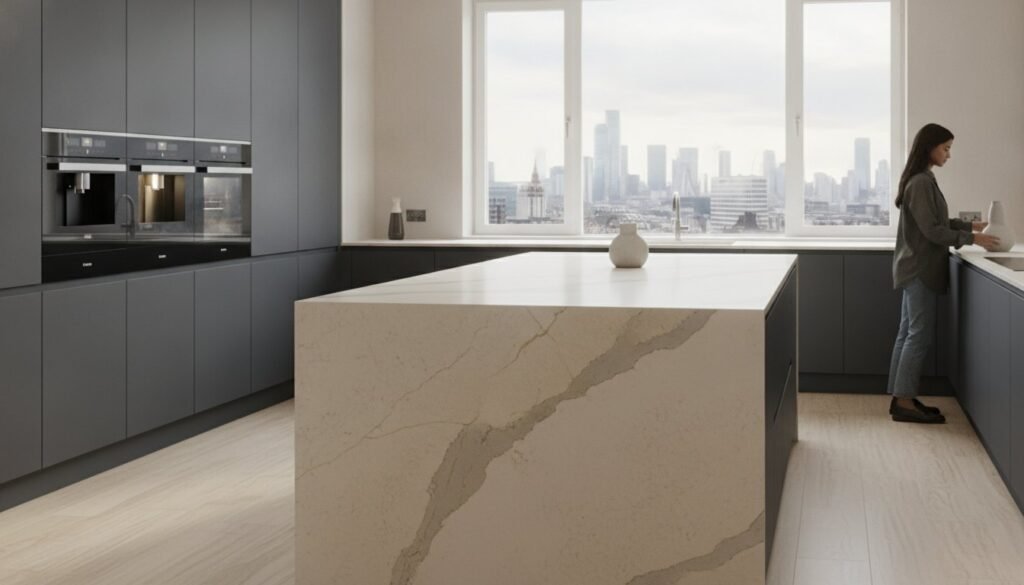
Understanding the nuance between these styles is vital for a high-end finish. Calacatta quartz features bold, dramatic veining against a crisp white background, making it a perfect centrepiece for a kitchen island. Carrara, by comparison, offers a softer, more mottled appearance with delicate grey plumes. These remain the gold standard for luxury kitchen worktops in London. To achieve a professional result, our master craftsmen focus on vein alignment during the templating phase. We ensure that the patterns flow logically from the horizontal worktop up into the vertical splashback. This creates a continuous, unbroken visual journey across your surfaces.
Industrial Greys and Concrete Textures
We’re seeing a significant shift from traditional polished surfaces to “suede” or “matte” finishes. These non-reflective textures are excellent for kitchens with large windows or industrial-style lighting, as they don’t produce a distracting glare. Grey quartz worktop colours are incredibly versatile, adapting well to the shifting natural light of a London day. To prevent an industrial space from feeling “overly cold”, we recommend choosing greys with warm, sandy undertones. These shades provide the edge of concrete with the comfort of a lived-in home. If you’re unsure which texture suits your cabinetry, we provide free samples to help you compare finishes in your own kitchen.
By categorising your preferences early, you move from confusion to clarity. Whether you prefer the dramatic sweeps of a Calacatta slab or the understated cool of a matte grey, the goal is a surface that feels intentional and tailored to your lifestyle. Choosing the right quartz worktop colours is about more than just a shade; it’s about the texture, the finish, and how the stone interacts with the soul of your home.
Matching Stone to Space: Lighting and Cabinetry Coordination
London’s property landscape is uniquely varied. A subterranean basement flat in Chelsea faces very different lighting challenges than a glass-walled penthouse in Canary Wharf. When choosing quartz worktop colours, you must consider how the specific architecture of your home dictates the behaviour of light. We often apply the 60-30-10 rule to ensure a balanced aesthetic. Under this framework, 60% of the room’s colour comes from the walls and cabinetry, 30% from the worktops and flooring, and 10% from accents like hardware or lighting fixtures. This methodical approach prevents any single element from overpowering the space, ensuring your stone choice complements rather than competes with its surroundings.
Modern LED under-cabinet lighting is now a standard feature in high-end renovations. However, these lights can create sharp, pinpoint reflections on highly polished quartz surfaces. If your design includes extensive LED strips, a honed or matte finish might be a more practical choice. These textures soften the bounce of artificial light, creating a more diffused and comfortable glow across your preparation areas.
The Impact of Natural Light in London Homes
The direction your kitchen faces is a critical factor in how stone appears. North-facing light is naturally cooler and can make blue-grey quartz look surprisingly icy or flat. In these spaces, we recommend warm whites or creamy tones to inject a sense of cosiness. Conversely, south-facing “glass box” extensions receive intense, direct sunlight for much of the day. In these bright environments, dark or highly reflective quartz worktop colours can produce significant glare. Viewing your material samples in the centre of the room, rather than just under artificial showroom spotlights, is the only way to accurately judge how the colour will behave in your specific environment.
Coordinating with Bold Cabinetry Trends
The “dark kitchen” trend remains popular across London, with many homeowners opting for Navy or Charcoal cabinetry. These bold choices pair beautifully with high-contrast white quartz, which serves to brighten the room and prevent it from feeling enclosed. For a more organic feel, oak cabinetry finds its perfect partner in earthy, taupe-toned stones that highlight the wood’s natural grain. Tonal matching, where the stone’s base shade closely follows the cabinet’s hue, creates a seamless and sophisticated high-end look. This coordination ensures that the worktop feels like an integrated part of the furniture. Whether you’re aiming for a dramatic contrast or a subtle blend, the relationship between your cabinets and your stone is the foundation of a successful kitchen design.
From Sample to Slab: Ensuring Colour Accuracy in Your Installation
A small stone sample is a vital tool, but it’s only the starting point for your project. When you’re looking at complex quartz worktop colours with heavy veining or intricate patterns, a 10cm square cannot represent the full scale of a three-metre slab. It’s essential to use these samples as a tactile reference for texture and base shade whilst acknowledging that the final installation will have a much grander visual impact. We recommend using your samples to test the material’s legendary durability. Even though quartz is non-porous, placing a drop of red wine or coffee on the surface overnight provides peace of mind that your chosen stone can handle the realities of a busy London kitchen.
The transition from a colour choice to a finished kitchen happens during the templating phase. This is where precision engineering meets aesthetic design. Our experts create a meticulous digital map of your cabinetry, accounting for every slight wall deviation or unique corner. This process is particularly critical for patterned stone. Templating allows us to “bookmatch” veins, ensuring that the movement in the stone flows logically across joins and around sinks or hobs. Professional on-site measurement is the only way to guarantee that the luxury finish you’ve invested in is actually delivered.
Why On-Site Templating is Non-Negotiable
Creating a physical or digital map of your kitchen units is the bridge between a raw slab and a precision-fitted masterpiece. Attempting DIY measurements for complex quartz patterns is a significant risk; even a few millimetres of error can ruin the visual continuity of a premium surface. Master craftsmen use the templating phase to decide exactly where each cut will fall. This allows us to align the most beautiful parts of the stone’s pattern with your kitchen’s most visible areas, such as a large central island. By mapping out the space professionally, we ensure that the finished product looks intentional and high-end rather than a collection of mismatched pieces.
Testing Your Samples Amongst Existing Finishes
To truly understand how your stone will look, you must observe it in its future home. Place your samples directly against your flooring, splashbacks, and paint swatches. Light in London shifts throughout the day; a stone that looks warm in the soft morning light might appear more clinical under evening lamplight. We encourage homeowners to move their samples around the room to see how the surface interacts with both natural and artificial sources. To help you make this decision with absolute certainty, we provide Free Quartz Worktop Samples London residents can use to test their design ideas in situ.
Choosing the right quartz worktop colours is an exciting step, but the installation quality is what makes those colours shine. If you’re ready to move from inspiration to installation, our team is here to guide you through every technical detail. You can enquire about our supply and fit service today to ensure your kitchen renovation is handled with the precision it deserves.
Bespoke Selection and Precision Fitting with London Worktops Experts
Choosing your quartz worktop colours is a significant investment in your home’s future value. However, even the most beautiful slab can be let down by poor installation. At London Worktops Experts, we bridge the gap between inspiration and reality. We operate as a dedicated “supply and fit” specialist, meaning we take full responsibility for your project from the initial measurement to the final polish. Being a local London partner means we understand the specific constraints of the capital’s housing stock. Whether you are in a Victorian terrace with uneven walls or a modern high-rise with complex access requirements, our team has the experience to navigate these challenges without stress.
Our commitment to excellence provides you with absolute peace of mind. We don’t just deliver stone; we deliver a precision-engineered surface that is designed to last a lifetime. By managing the entire process in-house, we ensure that the vision you had when first looking at samples is exactly what appears in your finished kitchen. The journey from initial colour inspiration to a precision-fitted worktop is a collaborative one, guided by our technical expertise and your unique style.
Our Precision Process: Templating, Supply, and Fit
We provide a comprehensive end-to-end service that removes the traditional stress of kitchen renovations. Our team focuses exclusively on bespoke stone masonry. We don’t provide full kitchen cabinetry or materials like wood; this specialisation allows us to maintain a standard of craftsmanship that generalists simply cannot match. The process begins with a professional on-site measurement where we use advanced tools to create a perfect template of your space. We invite you to book an on-site measurement today to receive a precision quote tailored to your specific kitchen layout.
The Transformation: Why Professional Installation Wins
The difference between a “good” installation and a “flawless” one is most visible in the joins. In patterned quartz, a master craftsman ensures that the veining flows naturally across every surface, maintaining the illusion of a single, solid piece of stone. Our fitters are experts at handling the unique challenges of London installations, from managing tight parking to ensuring heavy slabs are safely transported into upper-floor apartments. This meticulous attention to detail ensures your kitchen looks high-end from every angle.
Ready to transform your kitchen with the latest stone trends? Contact London Worktops Experts for a bespoke quote and let our master craftsmen bring your vision to life with precision and care.
Bringing Your 2026 Kitchen Vision to Life
The shift towards warm, organic palettes and sophisticated industrial textures offers a unique opportunity to create a sanctuary within the city. Selecting the perfect quartz worktop colours is only the first step in creating a truly bespoke space. Achieving a flawless result requires a deep understanding of how light interacts with stone and how intricate patterns flow across custom joins. It’s about more than just aesthetics; it’s about the technical precision that ensures longevity and peace of mind.
At London Worktops Experts, we pride ourselves on being specialists in premium London stone installations. Our master craftsmen handle the entire journey, providing bespoke templating and precision fitting that ensures your chosen material looks spectacular for years to come. We remove the uncertainty of the renovation process, delivering a high-end finish that is both durable and timeless. It’s our mission to ensure your kitchen reflects your personal style, supported by the highest standards of masonry and expert on-site measurement.
Take the next step towards your ideal home. Book Your Free On-Site Measurement and Sample Consultation today and let us handle the technical details for you. We look forward to helping you transform your space with confidence and care.
Frequently Asked Questions
What are the most popular quartz worktop colours in London for 2026?
Warm neutrals like taupe, greige, and soft terracotta are leading the 2026 trends across the capital. These shades are replacing the clinical whites of previous years, offering a more organic and biophilic feel. We are also seeing a rise in “suede” or matte-finish greys that complement industrial-style London renovations. These colours provide a versatile backdrop that works effectively across both Victorian restorations and modern apartment builds.
Do dark quartz worktop colours show more scratches or fingerprints?
Darker quartz worktop colours, particularly in polished finishes, can be more susceptible to showing fingerprints and water marks. Whilst the material itself is highly scratch-resistant, the high-gloss surface of deep blacks or charcoals tends to highlight oil and dust more than lighter patterns. For a lower-maintenance dark surface, we recommend choosing a “leathered” or matte finish. These textures diffuse light and help mask daily wear more effectively.
Can I get free quartz worktop samples delivered to my London address?
Yes, we provide free material samples to residents across the London area. Seeing the stone in your own kitchen is the only way to accurately judge how the colour interacts with your specific lighting and cabinetry. You can request a selection of your favourite shades to be delivered directly to your door. This service allows you to test the stone’s durability and appearance before committing to a full bespoke installation.
How do I choose a quartz colour that won’t go out of fashion?
Opting for subtle, marble-effect patterns or soft, neutral tones is the best way to ensure longevity. Classic Carrara or Calacatta styles have remained popular for decades because they pair effortlessly with almost any cabinetry colour. Avoid following hyper-specific, vibrant trends that might date quickly. Instead, focus on a palette that enhances the natural light in your home, as a well-lit and balanced space never goes out of style.
Does the colour of quartz affect its price or durability?
Colour primarily affects the price rather than the durability, as all high-quality quartz shares similar performance characteristics. The cost is usually determined by the complexity of the design; intricate veining and rare pigments require more intensive manufacturing processes. Whilst a plain white slab may be more affordable than a detailed marble-effect stone, both will offer the same non-porous and impact-resistant qualities required for a busy household kitchen.
How do I match my quartz worktop to my kitchen floor?
Aim for a tonal match or a clear contrast rather than trying to find an identical shade. If you have a dark floor, a lighter worktop can prevent the room from feeling too heavy. Conversely, matching the undertones of your stone with the grout lines or grain of your flooring creates a cohesive look. We suggest placing your stone samples directly on the floor at different times of the day to check for harmony.
What is the best quartz colour for a small, dark kitchen?
Light-reflecting whites and soft creams are the most effective choices for smaller, darker spaces. These quartz worktop colours help bounce available light around the room, making the area feel significantly more open and airy. A polished finish is particularly beneficial here, as it acts almost like a mirror to brighten dim corners. Combining light stone with pale cabinetry can transform a cramped galley kitchen into a more inviting space.
How does “veining” in quartz affect the cost of installation?
Heavily veined quartz often increases installation costs because it requires more complex templating and precision cutting. To achieve a high-end look, our master craftsmen must align the patterns at every join, which may require more material than a plain slab. This meticulous process ensures that the veins flow seamlessly across your worktops and splashbacks. Whilst it requires more planning, the result is a much more luxurious and professional finish.